Summary
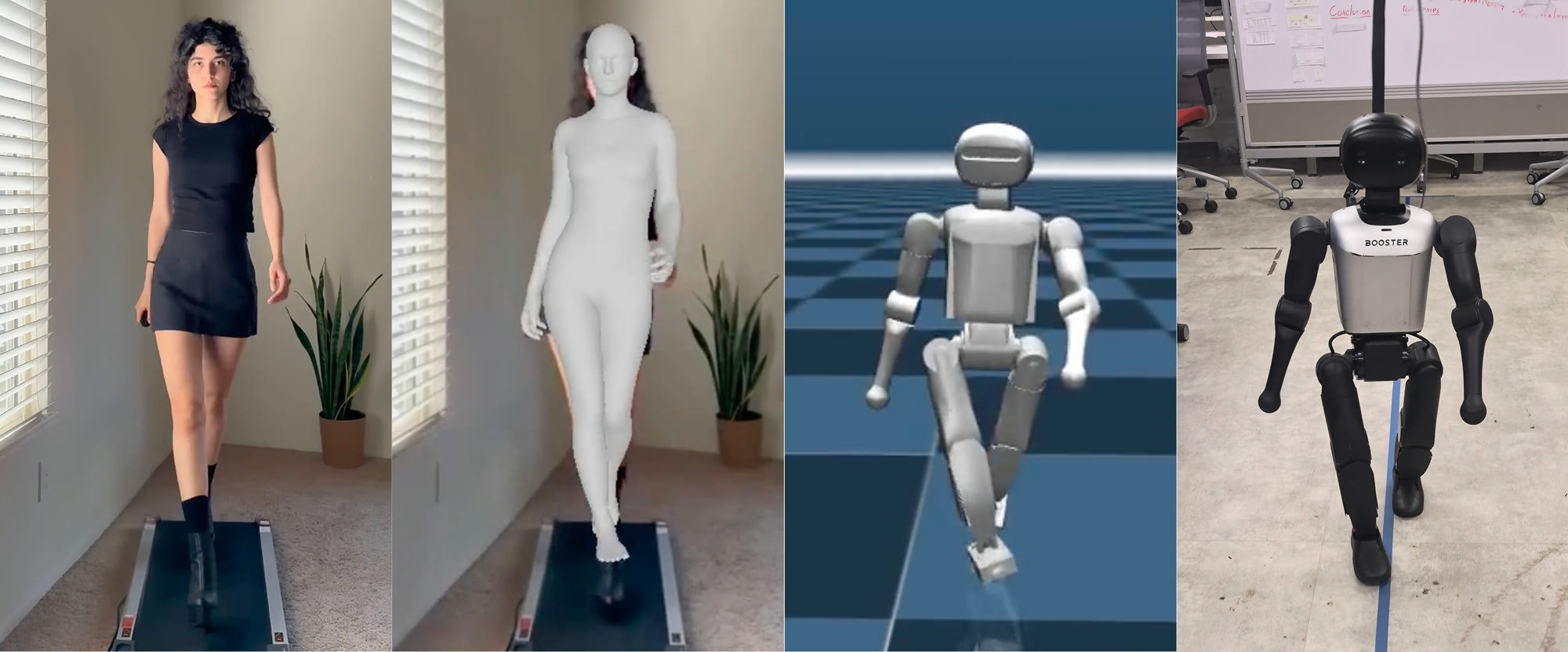
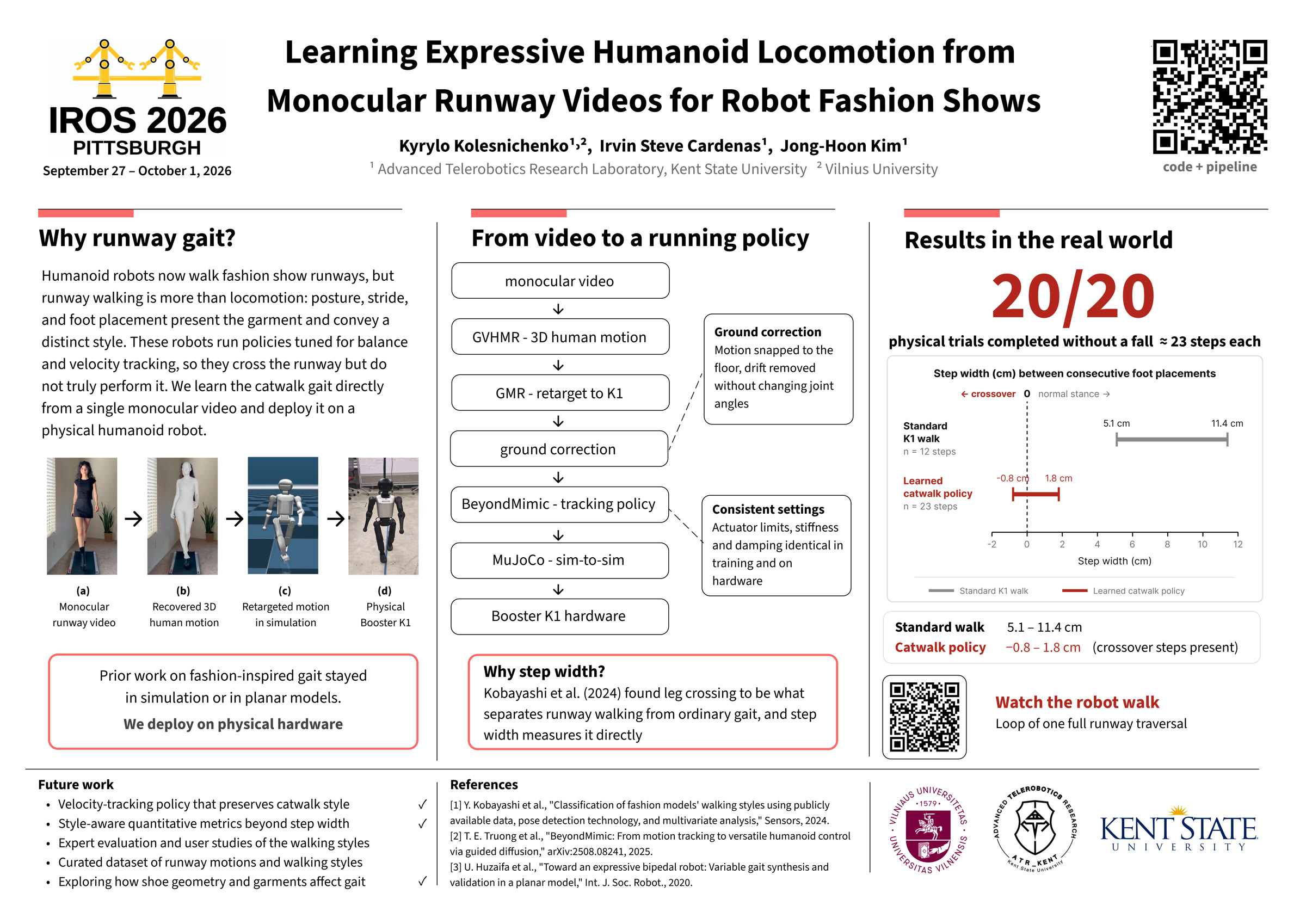
Locomotion controllers are tuned for stability and speed, not for how the walk looks. This project asks whether a humanoid can learn a recognisable runway walk from nothing more than an ordinary video of a person doing it. The pipeline takes a single monocular clip, recovers the 3D human motion, cleans it up, retargets it to the K1, and produces a motion-tracking task that trains a policy in Isaac Lab. The policy is checked in MuJoCo before it goes on the robot.
Pipeline
| Stage | Tool | Notes |
|---|---|---|
| Frames | ffmpeg | resample to 30 fps |
| 3D human motion | GVHMR | SMPL-X in world space, static-camera mode |
| Clean-up | this repo | foot contacts, floor levelling, root-drift removal |
| Retargeting | GMR | human skeleton → K1 joints (UMR in later variants) |
| Policy | BeyondMimic, Isaac Lab | motion-tracking RL |
| Check | MuJoCo | sim-to-sim before hardware |
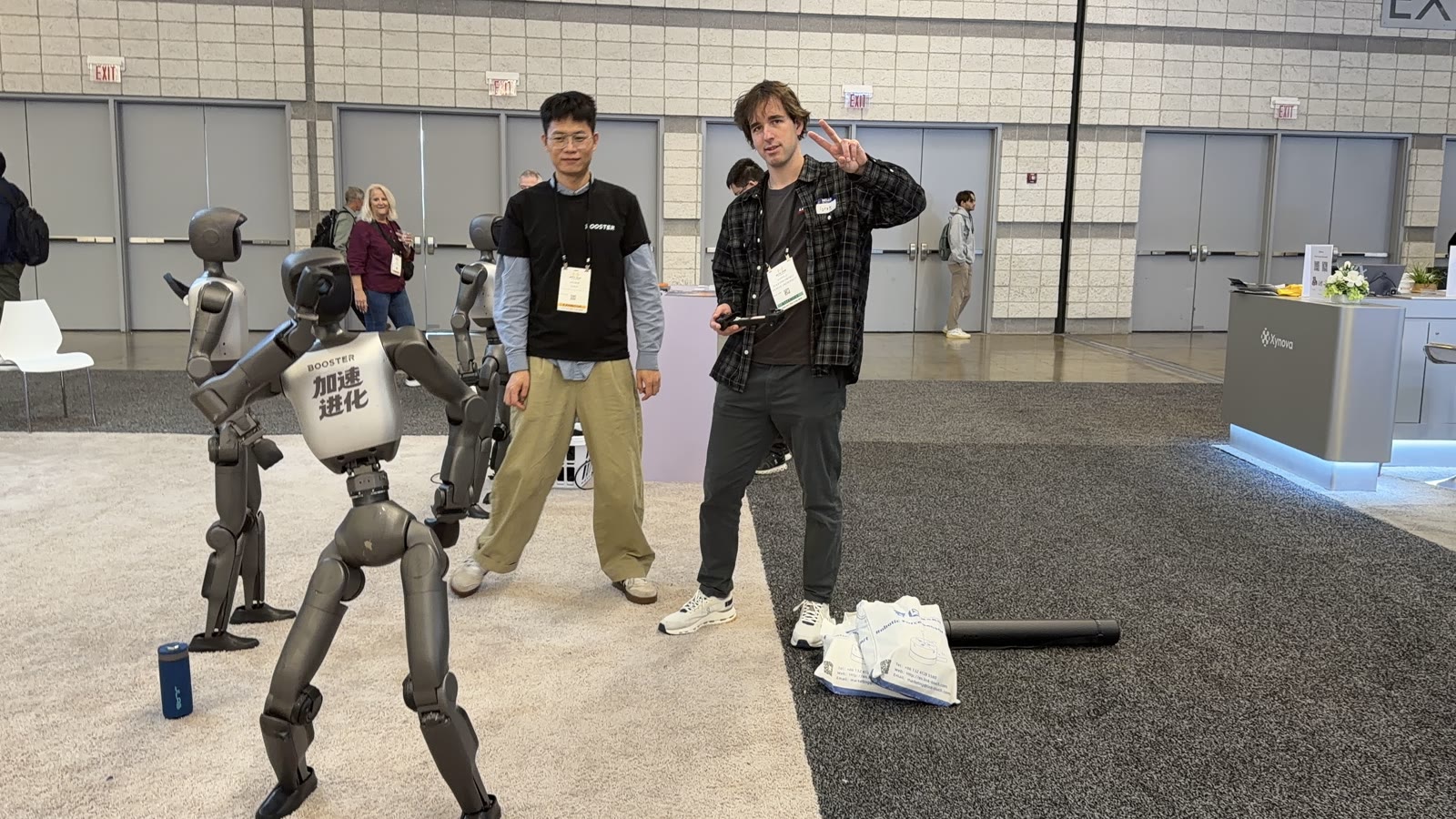
| Robot | Booster K1 | physical trials |
Results
On the physical K1, over a 5 m runway:
- 20 of 20 trials completed without a fall, about 23 steps each.
- Step width of −0.8 to 1.8 cm for the learned gait, against 5.1 to 11.4 cm for the stock K1 walk. A negative width means the feet cross the midline: the policy produces occasional crossover steps, which is what a runway walk looks like.
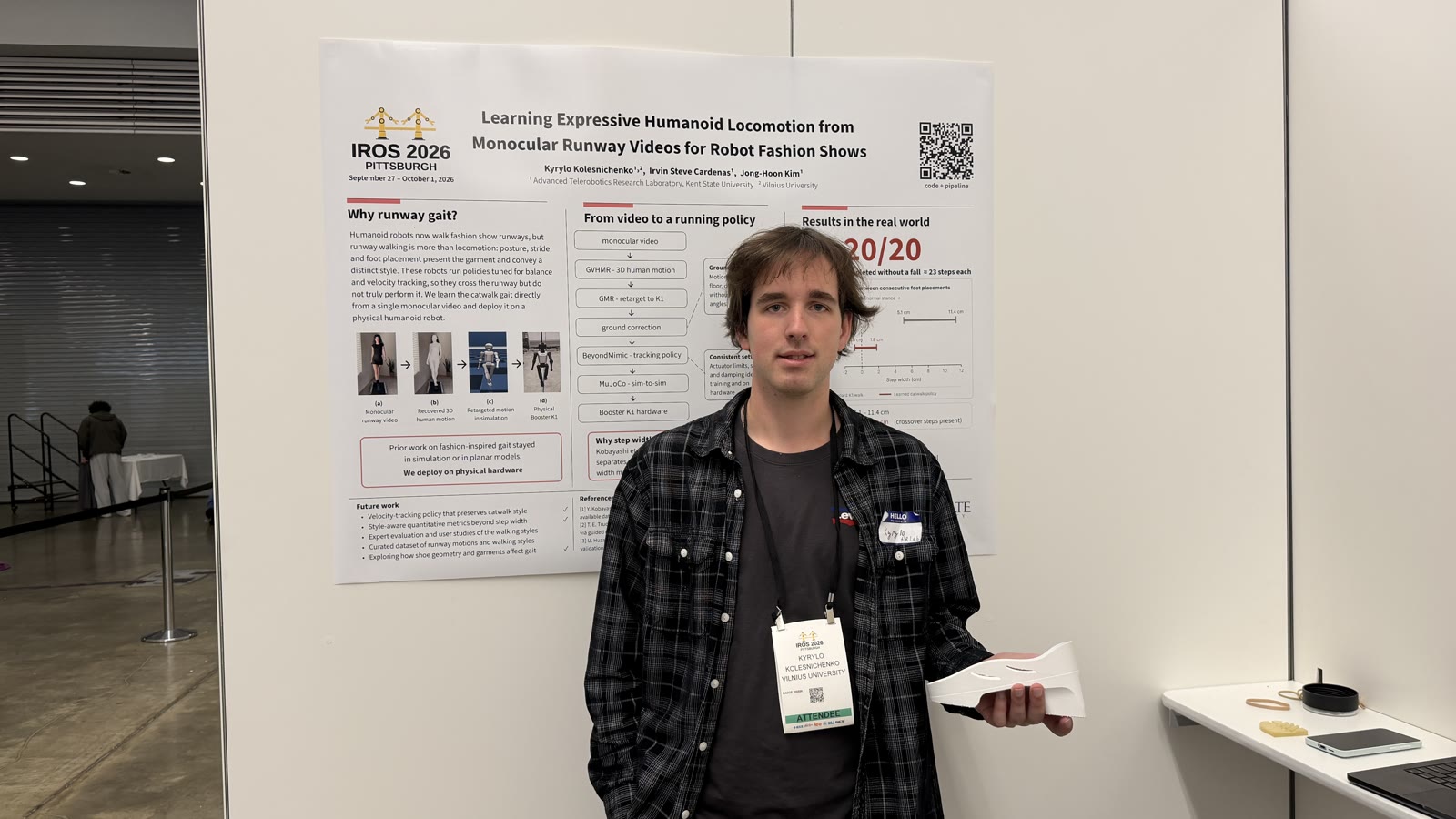
The paper is a Late Breaking Results poster at IROS 2026.1
Release
Notes from packaging the code: what it takes to get a fresh machine to the point where
process.py runs at all.
Two environments, on purpose. GVHMR (video → 3D human motion) and GMR (human → robot retargeting) pin incompatible dependencies, so the install script creates two:
| Environment | Used for |
|---|---|
expressive-motion |
retargeting, CSV conversion, task generation. The one you activate. |
expressive-motion-gvhmr |
GVHMR inference on the GPU. Called by process.py; you never activate it. |
The cost is about 25 GB of disk. The benefit is that neither tool’s install can break the other’s.
Linux x86_64 only. The pinned pytorch3d wheel exists only for linux_x86_64.
GVHMR needs an NVIDIA GPU with CUDA 12.1+; nothing else in the pipeline does, so
bash install.sh main skips it on machines without a GPU.
The weights are the real blocker. About 5.2 GB, none of it downloadable by a script: SMPL and SMPL-X need separate registrations with signed licences, and the GVHMR checkpoints come from the upstream Google Drive folder. The README has a table of every file, its size and what needs it.
Static camera, so no DPVO. Runway videos are shot from a fixed camera, so GVHMR runs in static-camera mode and the visual-odometry model is skipped.
Isaac Lab itself is never installed by the script. bash install.sh isaac <env> only
adds the Booster packages to an Isaac Lab environment you already have.
Footnotes
-
An LBR poster, not a full conference paper. The arXiv version is listed as an “IROS 2026 Poster Paper”. ↩
Media
Paper
- Learning Expressive Humanoid Locomotion from Monocular Runway Videos for Robot Fashion ShowsIEEE/RSJ International Conference on Intelligent Robots and Systems (IROS 2026), Late Breaking Results (LBR), 2026