Summary
Co-author. This is joint work with Raiyan Ashraf (lead), Yanni Liu, Sruthi Ganji, Jong-Hoon Kim and Ju Yup Lee.
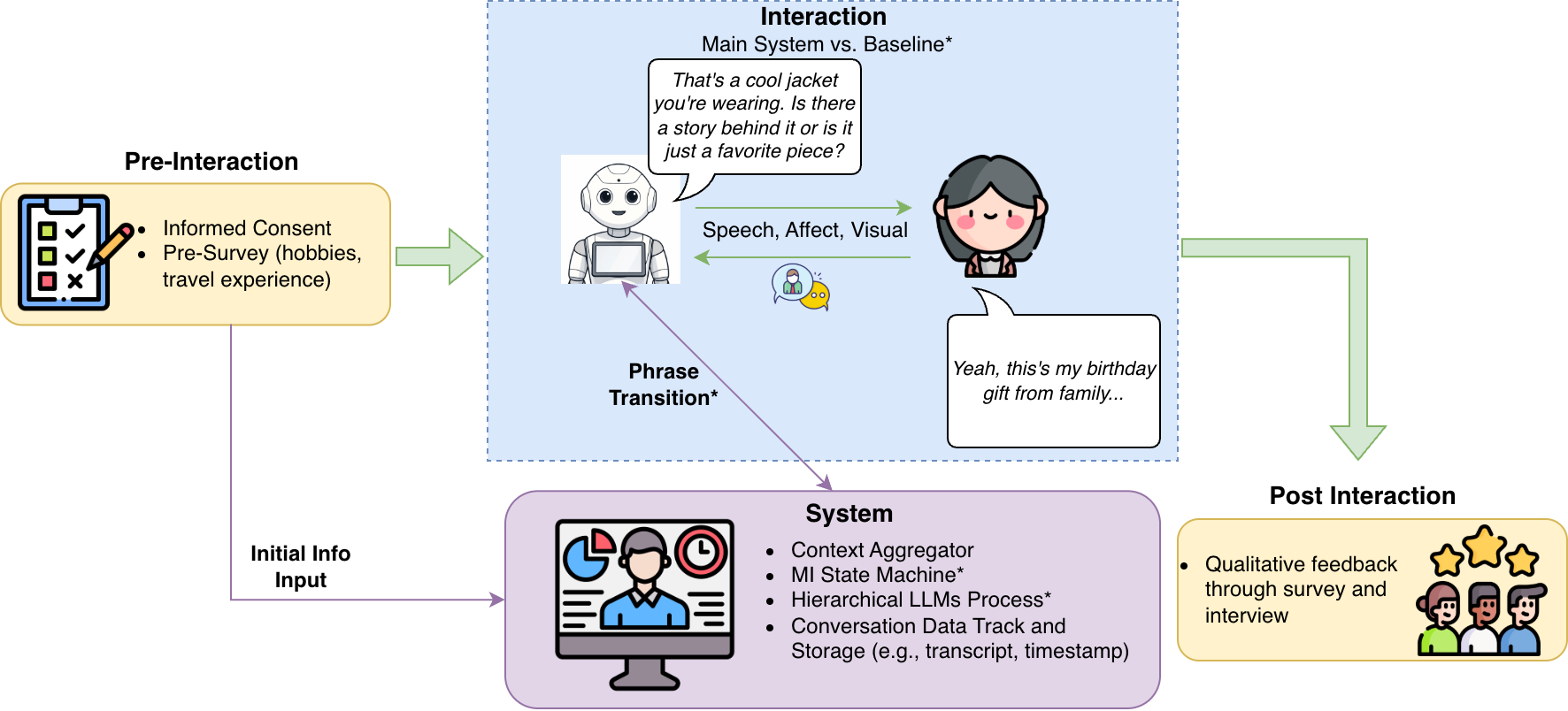
LLM-based social robots mostly react to the last thing said. Mi-RoL gives the conversation a structure based on Motivational Interviewing (MI), and grounds it in the user’s situation: what the robot sees, what it knows about the user, and what they talked about before.
How it works
The framework splits reasoning from response. At each stage boundary a bigger reasoning model looks at the context, estimates engagement and emotion, picks the strategy and decides when to move on. A fast response model says the actual lines in between. The stages are Intro, Engage, Affirm & Reflect, Evoke and Expand.
Speech is transcribed with Whisper and Silero voice activity detection. GPT-4o picks out the user’s appearance and the objects around them, and that goes into one shared context together with the user’s personal info.
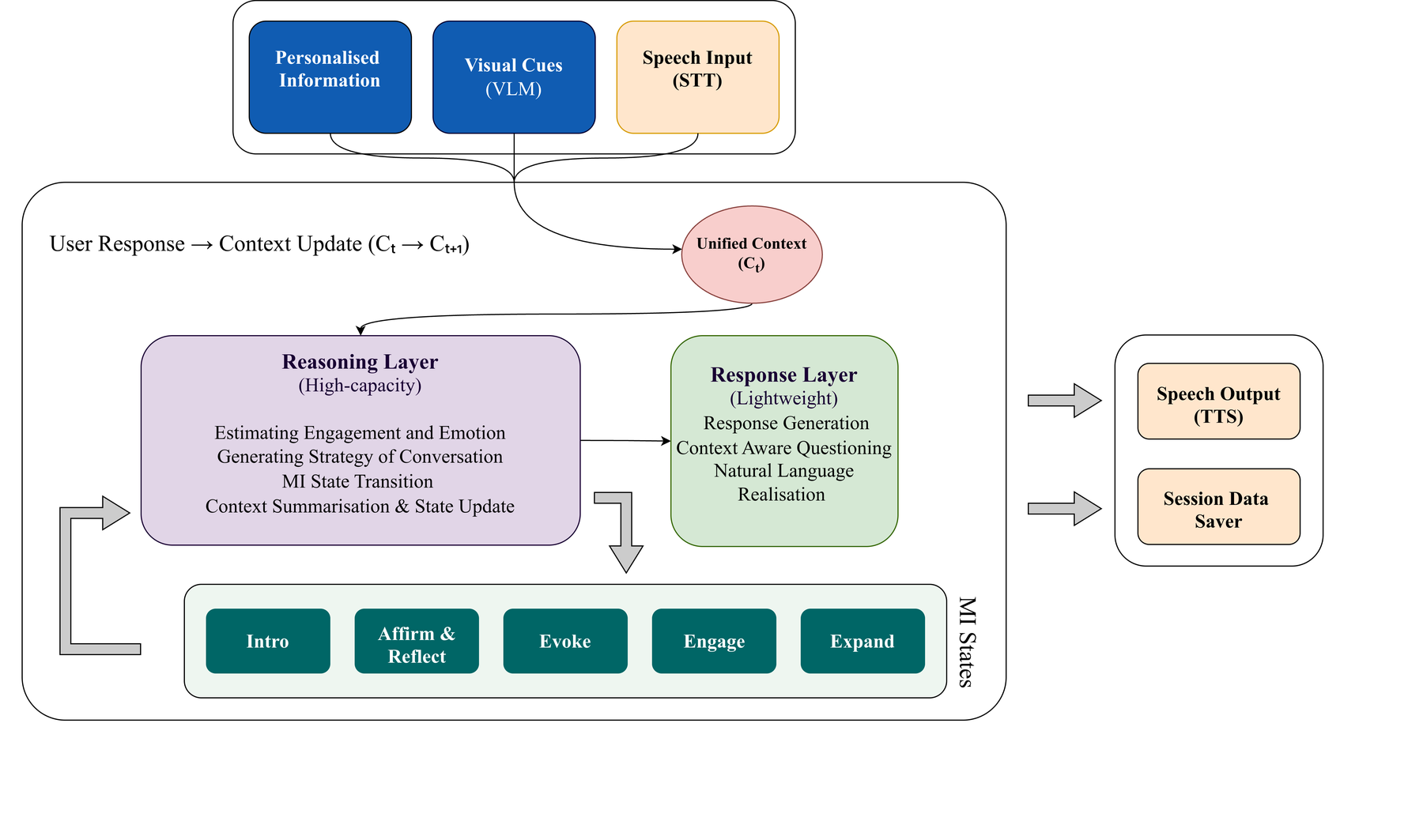
Nine model pairings were compared first: three reasoning models (GPT-4o, Gemini 2.5 Pro, Llama 3 8B) against three response models (GPT-4o-mini, Gemini 2.5 Flash, Llama 3.2 3B), rated by four researchers. GPT-4o for reasoning with Gemini 2.5 Flash for responses came out on top and was used in the study.
Study
40 participants, between-subject, with a physical Pepper. Each person had a 7–10 minute conversation with either Mi-RoL or a baseline: unstructured, reactive dialogue from a single GPT-4o.
| Baseline | Mi-RoL | effect size d | |
|---|---|---|---|
| Perceived empathy | 3.46 | 3.90 | 0.68 |
| User engagement | 3.58 | 4.06 | 0.75 |
| Social presence | 3.15 | 3.88 | 0.88 |
| Intention to use | 3.55 | 4.12 | 0.65 |
All four were significantly better with Mi-RoL (5-point scales, p < .05), and social presence improved the most. People liked it most when the robot noticed something they had with them, like a backpack or a tumbler, and connected it to their own stories.
Paper
- Can Motivational Interviewing Guided Dialogue Improve Empathy in Human–Robot Interaction? A Controlled Study with Baseline ComparisonInternational Conference on Intelligent Human–Computer Interaction (IHCI 2026), 2026