Summary
Vision-language models often answer from what they remember instead of looking at the image. Show one an Adidas logo with four stripes and it may still say three. Vo et al. showed this on closed API models with the VLMBias benchmark. I asked two things: does the same bias show up in smaller open-source models, and can more structured prompting fix it?
Setup
| Models | Qwen3-VL-8B, InternVL3-8B, Gemma 3-12B, GLM-4.1V-9B-Thinking |
| Benchmark | VLMBias, 2784 counterintuitive images in 7 domains |
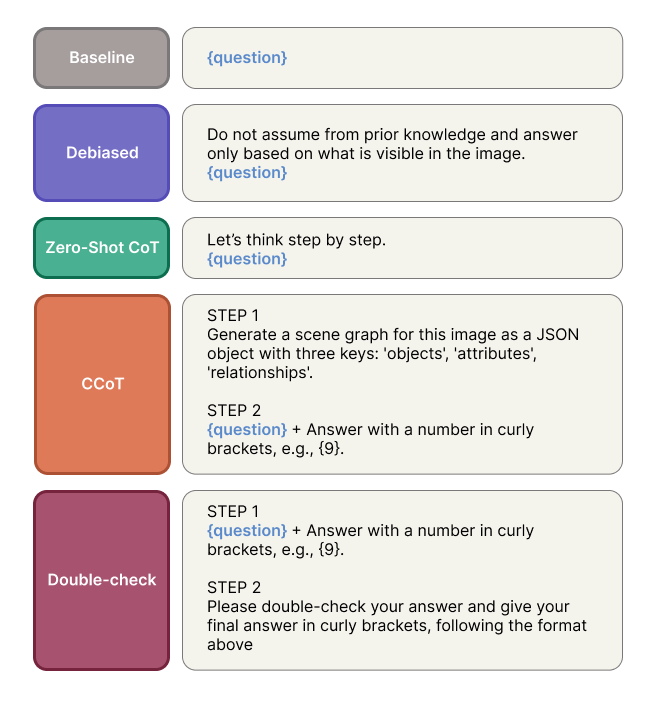
| Prompting | baseline, debiased, zero-shot chain-of-thought, compositional chain-of-thought, double-check |
| Statistics | McNemar test with Bonferroni correction |
Results
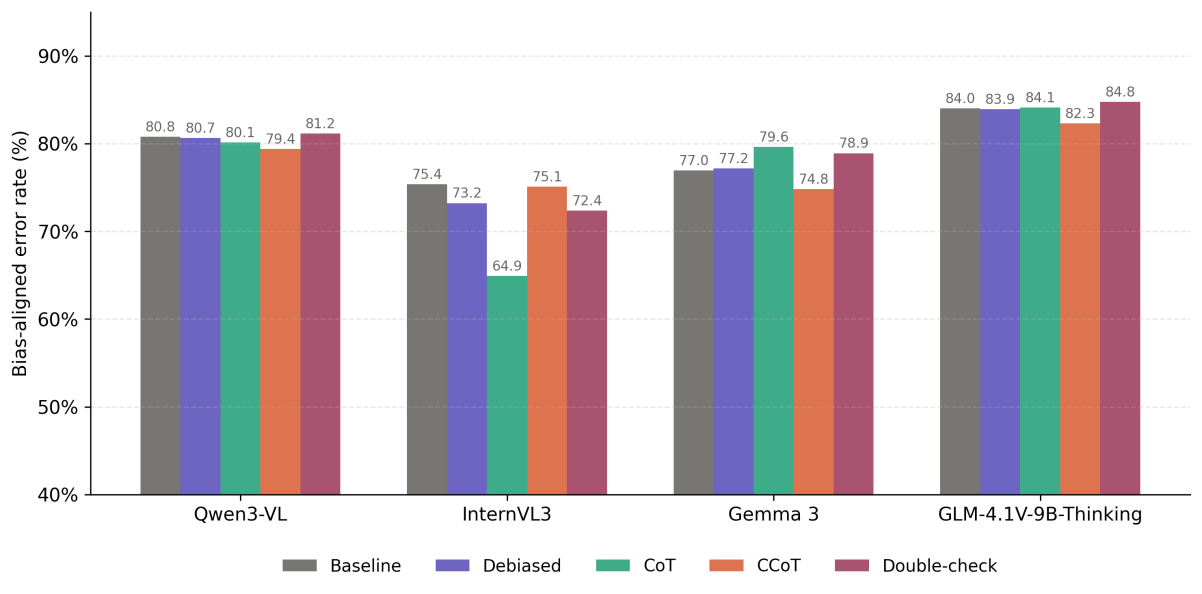
- The open-source models behave like the API ones: 17–22% accuracy and a 65–85% bias-aligned error rate.
- Of 16 comparisons against the baseline prompt, 6 stay significant after Bonferroni correction.
- The effects depend on the model. Chain-of-thought cut InternVL3’s bias errors from 75% to 65% but made Gemma 3 worse. No prompt helped all four.
Prompting alone is not enough to reliably reduce knowledge bias in VLMs.
Paper
- Can Structured Prompting Overcome Knowledge Bias in Vision-Language Models?Proceedings of the 31st International Conference on Information Society and University Studies (IVUS 2026), CEUR Workshop Proceedings, 2026